LET'S DIVE!
> Scuba diving in Cenotes
The Yucatan Peninsula is formed, completely, of limestone.
 It's porous nature
let the rain go through, creating caverns along the time. Those caverns were forming stalactites and
stalagmites -some of them are immense-. After the last Ice Age, the deepest caverns were flooded by water
coming from thawing.
It's porous nature
let the rain go through, creating caverns along the time. Those caverns were forming stalactites and
stalagmites -some of them are immense-. After the last Ice Age, the deepest caverns were flooded by water
coming from thawing.
Cenotes are the way to enter caverns. They were formed when the ceiling of
caves collapsed and and left open spaces which were flooded by rain.
Caverns are filled with
spring water to about 35 feet. Below that depth divers can experience the haloclines, an interesting union
of fresh water and salt water, without mixing to each other. In open cenotes (those caverns which collapsed
completely) is usual to find thermoclines, a union of hot and cold water, also without mixing to each
other.
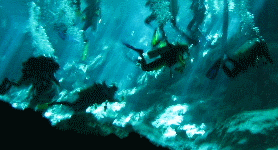
Divers with an Open Water certification can dive cenotes, because, since cenotes are
caverns and not caves, they offer open spaces with a quick access to surface. In those open spaces, it's
very common to see an unmatched spectacle of light as it enters the crystal clear water, that leaves in
divers an unforgetable view.
Almost any cenote can be visited for diving, however, the most
attractive ones are Kukulkan, Chac Mool, Dos Ojos, Angelita, Calavera and El Eden.
For security
reasons, we only take up to 4 divers per full cave instructor guide in each dive.
SPECIAL PACKAGES: (3 Divers min.)
* We offer to you a 3-day cenote dive! or
* For the same price we offer to you a 3-day dive: 1 in Playa del
Carmen, 1 in Cozumel and 1 in a cenote.
In all cases you have a 2-tank dive per day, so you do 6 tanks!
Entrance fee to cenotes
(varies from 10 tu 20 USD) and ferry to Cozumel (30 USD) not included.
If you don't have your own
gear when diving with us, you can rent one from us. In this case please add 15 USD per day to the
price.
Go for it!
|
Follow these links to learn more about other destinations:
|
|